My AI built the whole thing. It handed back the keys, the money, and the final yes.
Twice in one day, my AI built something end to end — a payment system, then a whole website — and both times handed me a short list of what it couldn't do. Nothing on either list was hard. Every item was the same three things — and they map exactly where your job with AI actually is now.
Archived
I wrote this in July 2026 and I don’t keep it up to date. What I’m writing now:
Twice in one day, my AI built something end to end — and both times, the last thing it did was hand me a short list of what it couldn't do.
Not because those things were hard. The AI had just done genuinely hard things — built a working payment system, rebuilt an entire website, put both on live servers. The list it handed back wasn't the hard stuff. It was a different kind of stuff. And once I saw the shape of it, I understood the real division of labor between me and the AI better than any explainer had managed.
The first handoff: switching on online ordering
That morning, the job was taking a friend's food-truck online-ordering system live — cart, card payment, order confirmation, the works. The AI had built and tested all of it. My friend had even run a real test order through it, start to finish. The code was done.
Then it handed me a list. Six steps. Here's what was on it:
- Sit with my friend and pull his payment credentials. These live inside his account with the card-processing service — I can't get them, and honestly I shouldn't; they're his.
- Decide, with him, where the menu comes from — does he want to edit his own prices, or should we keep them in the code? His business, his call.
- Put those credentials into my hosting account — and get one setting exactly right, because the wrong value there would start charging real money on the demo.
- Press the button that makes it live. One click, and the site takes real orders. That click had to be mine.
- Prove it's real with my own card — buy the cheapest thing, watch it ring up on his register, then refund it.
- Have him announce it to his customers. An unannounced feature earns nothing.
Look at that list. Not one of those is "hard" the way building a payment system is hard. But every single one is something the AI structurally can't do — because each one runs on someone's account, someone's money, or someone's say-so.
The second handoff, same day: launching my own site
Hours later, different project — putting my own site live at its real web address. Again the AI had done the heavy lifting: rebuilt the site, merged the changes, pushed it to live servers, even noticed on its own that my web address was still pointing at my old hosting.
And again, a short list came back. Three things this time:
- Log into my hosting dashboard and add my web address. My login. The AI doesn't have it.
- Point that web address at the new site — done inside my domain account, the one only I can sign into.
- Publish it under my own name — put the link somewhere a real person would actually see it.
Same shape as the first list. Accounts only I can log into. And one act that has to be mine: putting my name on it and saying "this is live."
The pattern in what stayed mine
Here's the thing I keep coming back to. When people ask "what can AI actually do?", they picture a line between hard and easy — the AI takes the hard technical stuff, you keep the simple bits. That's not the line at all.
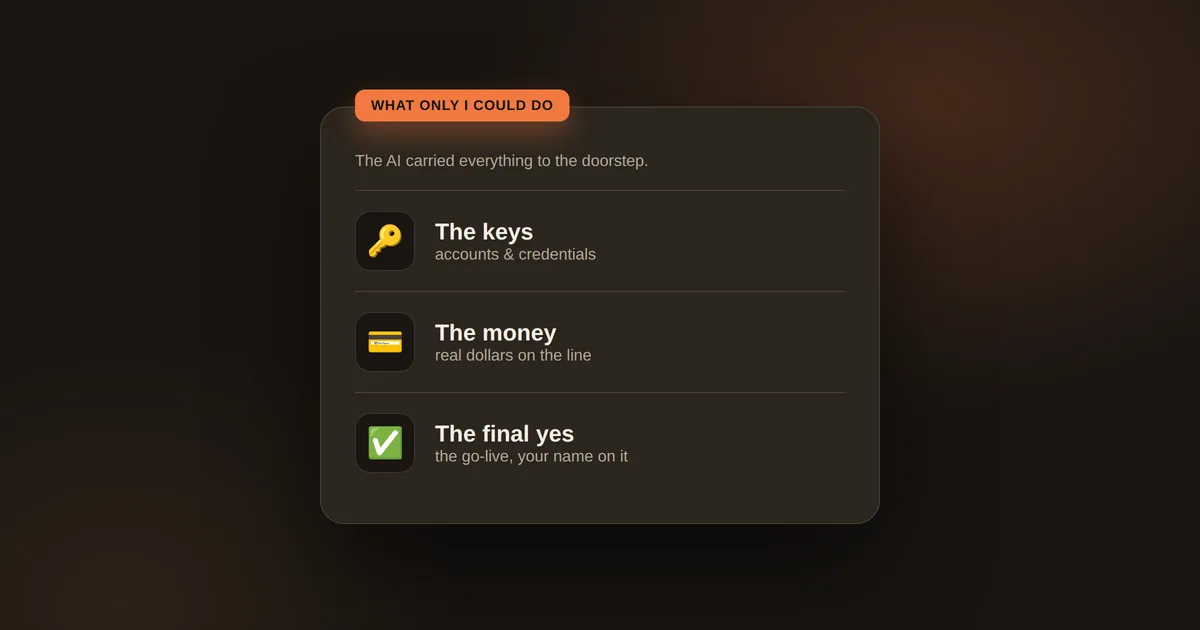
The AI carried the hard, technical, tedious work all the way to the doorstep — twice. What it handed back wasn't easier. It was mine in a way that has nothing to do with difficulty. Every leftover item was gated on one of three things:
- The keys — credentials and accounts that belong to me, or to someone else. The AI can't hold them, and it shouldn't.
- The money — spending real dollars, or a setting where a mistake spends them for you.
- The final yes — the irreversible go/no-go, and putting your own name behind it.
That's the real division of labor with AI. Not hard versus easy. Who holds the keys, the money, and the final yes.
Why this is the good news
It sounds like a limitation. It's actually the most useful map I've got.
Because it tells me exactly where my job is now. It isn't in the parts the AI carries — I can stop white-knuckling those. My job is the doorstep: the judgment calls (where should the menu live?), the relationships (sitting with my friend, pulling his credentials together), the responsibility (my card, my login, my name on the launch).
Those are the parts that were always the point. The AI handling the plumbing frees me up for them, not out of them. The last mile — the keys, the money, the yes — is human on purpose. Which is exactly why it's the part worth getting good at.
And one more thing about that list: the AI didn't pretend it could do those steps. It told me, plainly, what it couldn't — and why each one was mine. That honesty is part of the work too. A tool that carries the load all the way to your door and tells you exactly what's left for you is a good collaborator. It's just never going to hold your keys.
Thanks for reading.